




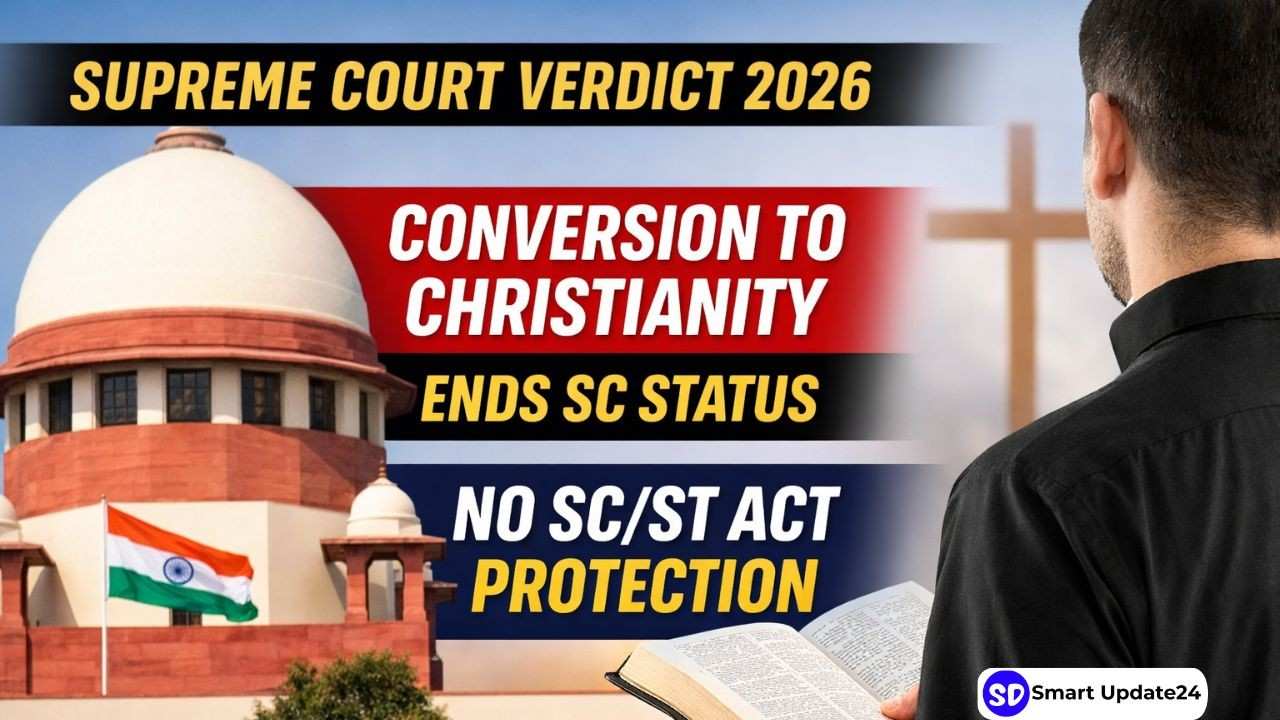
Supreme Court Rules Conversion to Christianity Ends SC Status: New Delhi, March 26, 2026: The Supreme Court ruled on Tuesday that an individual professing a religion other than Hinduism, Sikhism, or Buddhism cannot be deemed a member of a Scheduled Caste.
The apex court stated that adopting any other religion results in the forfeiture of this status.
A bench comprising Justice P.K. Mishra and Justice N.V. Anjaria upheld an order issued by the Andhra Pradesh High Court. In its order, the High Court had held that individuals who convert to Christianity and practice it with full devotion cannot retain their Scheduled Caste (SC) status.
In a significant judgment, the Supreme Court of India has clarified that individuals who convert to Christianity or any religion outside Hinduism, Sikhism, or Buddhism will lose their Scheduled Caste (SC) status and cannot claim protection under the SC/ST (Prevention of Atrocities) Act.
The ruling reinforces constitutional provisions and settles a long-standing legal question regarding caste identity after religious conversion.
OVERVIEW of the Supreme Court judgments, March 26, 2026
- Conversion to Christianity leads to the complete loss of Scheduled Caste status
- SC/ST Act protections cannot be claimed after conversion
- The restriction under the Constitution (Scheduled Castes) Order, 1950, is absolute
- Holding a caste certificate does not guarantee benefits after conversion
Background of the Case (Supreme Court Rules Conversion to Christianity)
The case, titled Chinthada Anand v. State of Andhra Pradesh, was filed by a pastor who alleged caste-based abuse and sought protection under the SC/ST Act.
An FIR was initially registered based on his complaint. However, the accused challenged the case, arguing that the complainant had converted to Christianity and therefore was no longer eligible for Scheduled Caste protections.
The Andhra Pradesh High Court agreed with this argument and quashed the FIR, leading to an appeal in the Supreme Court.
Supreme Court’s Observations
A bench comprising Justices Prashant Kumar Mishra and N V Anjaria upheld the High Court’s decision.
The Court clearly stated:
- Only individuals practicing Hinduism, Sikhism, or Buddhism are recognized as Scheduled Castes under the Constitution.
- Conversion to any other religion results in immediate disqualification from SC status.
- The restriction under Clause 3 of the 1950 Order is strict and without exceptions.
The Court also emphasized that a person cannot simultaneously claim SC status while practicing another religion.
Role of the 1950 Presidential Order
The judgment heavily relied on the Constitution (Scheduled Castes) Order, 1950, which defines who qualifies as a Scheduled Caste.
According to this Order:
- SC status is restricted to specific religions
- Conversion outside these religions leads to automatic loss of benefits
The Court reiterated that this legal position is binding and cannot be bypassed.
Important Clarifications by the Court (Supreme Court Rules Conversion)
- Caste Certificate Not Enough
The Court clarified that merely holding a Scheduled Caste certificate does not entitle a person to benefits if they have converted.
- Religion Determines Eligibility
Eligibility depends on the current religion practiced, not past identity.
- No Evidence of Re-conversion
In this case, the petitioner had:
- Practiced Christianity for over a decade
- Worked as a pastor
- Conducted regular religious activities
Hence, the Court found no ambiguity about his religious identity.
Related Article: WB 19 Appellate Tribunals Announced on 20 March (District-Wise) | Election Commission Acts on Supreme Court & High Court Orders
Supreme Court Official Website: https://www.sci.gov.in/