


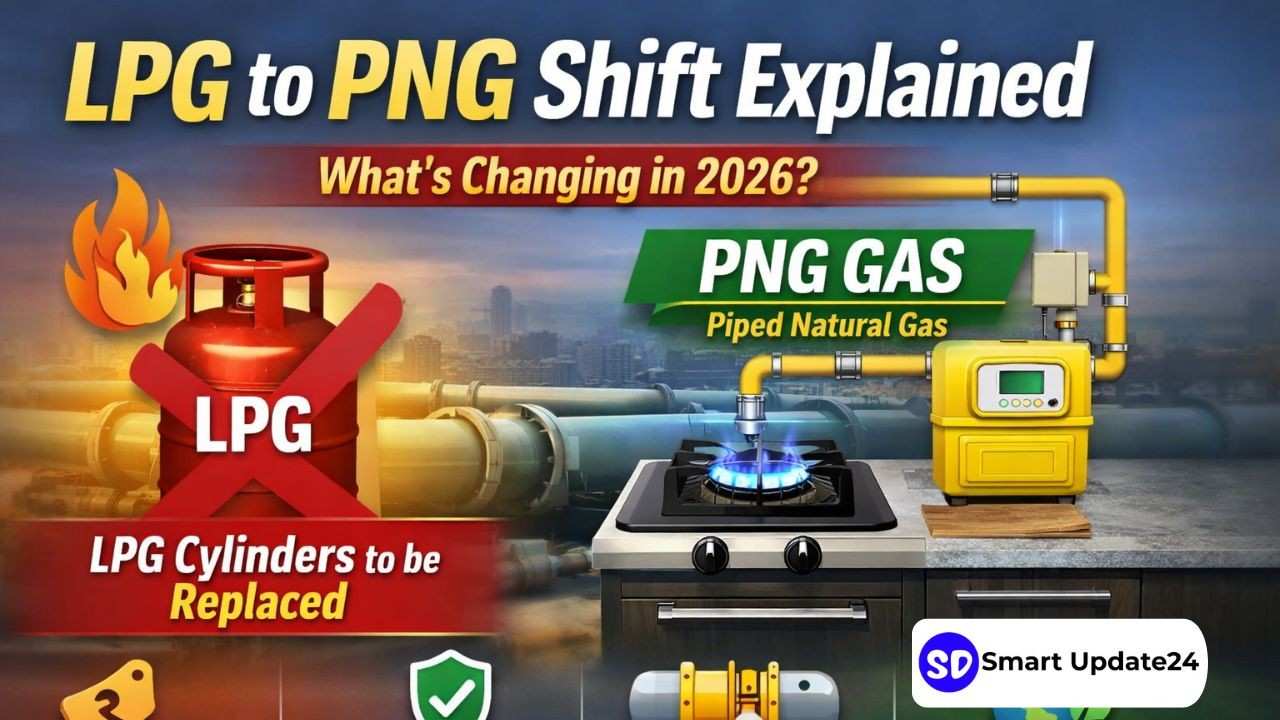
PNG Gas vs LPG: India is witnessing a major shift in its domestic cooking fuel policy, as the central government strongly encourages households and commercial users to move from LPG cylinders to piped natural gas (PNG). The move comes amid concerns over LPG supply pressure and rising import dependency.
Recent directives suggest that in areas where PNG is available, LPG supply may be restricted or even stopped if consumers do not switch within a given time.
At the same time, authorities have clarified that there is no immediate shortage, but the transition is part of a long-term strategy to ensure stable, cleaner, and more efficient fuel usage.
PNG Gas Overview Chart (2026)
| Category | Details |
|---|---|
| Full Form | Piped Natural Gas (PNG) |
| Type of Gas | Natural gas (mainly Methane – CH₄) |
| Supply Method | Through underground pipelines |
| Usage Area | Homes, hotels, industries |
| Billing System | Monthly, based on meter usage |
| Average Price | ₹35 – ₹60 per SCM (city-wise varies) |
| Compared to LPG | Usually cheaper in long term |
| Government Policy (2026) | LPG users encouraged/mandated to shift where PNG is available |
| Availability | Metro cities and expanding urban areas |
| Connection Process | Apply → Installation → Meter setup → Gas activation |
| Safety Level | High (lighter than air, disperses quickly) |
| Main Benefits | Continuous supply, no cylinder, safer, eco-friendly |
| Main Drawbacks | Limited coverage, installation cost, pipeline dependency |
| Best For | Urban households with pipeline access |
| Backup Needed? | No (but LPG optional in some cases) |
What is PNG Gas? (Full Form & Meaning)
PNG Full Form: Piped Natural Gas
PNG is a form of natural gas supplied directly to homes and industries through underground pipelines, eliminating the need for LPG cylinders.
- It mainly contains methane (CH₄)
- Delivered continuously through a pipeline network
- Meter-based billing, like electricity or water
Unlike LPG (Liquefied Petroleum Gas), which is stored in cylinders, PNG is supplied directly from city gas distribution systems.
Related Article:LPG ATM 2026 | India’s First 24×7 Cooking Gas Vending Machine Launched by BPCL
Why the Government is Promoting PNG
The push for PNG is driven by multiple reasons:
- India imports around 60% of its LPG needs, making it vulnerable to global disruptions
- Global tensions (like West Asia issues) can affect LPG supply
- PNG reduces pressure on cylinder distribution
- It supports cleaner fuel adoption
Authorities are also offering incentives in some cities to encourage early adoption.
How PNG Gas Works (Usage Process)
- Gas is transported via underground pipelines
- A regulator and gas meter are installed at home
- Gas flows directly to your kitchen stove
- Billing is based on actual usage (monthly)
No cylinder booking, delivery, or storage is required.
PNG Gas vs LPG Quick Snapshot
| Feature | PNG Gas | LPG Cylinder |
|---|---|---|
| Supply | Continuous | Refill-based |
| Payment | Postpaid (monthly bill) | Prepaid |
| Safety | Safer | Higher risk if leaked |
| Convenience | Very high | Medium |
| Storage | Not required | Cylinder needed |
Price of PNG Gas vs LPG
PNG Price:
- Around ₹35–₹60 per SCM (standard cubic meter), depending on the city
LPG Price:
- ₹800–₹1100 per cylinder (14.2 kg, varies)
Key Difference:
- PNG is billed on usage
- LPG is prepaid and bulk-based
In many urban areas, PNG becomes cheaper over time due to controlled pricing and no delivery cost.
Related Article:LPG e-KYC Now Mandatory in India 2026 | How to link LPG Users with e-KYC -Step-by-step process -New Rules for Indane, Bharatgas and HP Gas Users
Benefits of PNG Gas
1. Continuous Supply
- No need to book cylinders
- No waiting for delivery
2. Safer Than LPG
- Lighter than air, disperses quickly
- Lower explosion risk
3. Cost-Effective
- Pay only for what you use
- No extra delivery or handling charges
4. Cleaner Fuel
- Produces less carbon and pollutants
- Supports eco-friendly cooking
5. Convenience
- No cylinder storage space needed
- Automatic supply system
Drawbacks of PNG Gas
1. Limited Availability
- Not available in all cities (e.g., parts of Kolkata still developing infrastructure)
2. Installation Cost
- Initial connection and pipeline setup charges
3. Dependence on Pipeline
- If supply is disrupted, no backup like LPG cylinder
4. Lower Heating Value
- PNG burns slightly slower than LPG
Safety Features of PNG
PNG systems are designed with multiple safety layers:
- Automatic shut-off valves
- Pressure regulators
- Leak detection systems
- Odor added for easy leak detection
Important Safety Tips:
- Always check for smell (like rotten eggs)
- Keep the kitchen ventilated
- Do not tamper with the pipeline
- Regular maintenance is essential
PNG vs LPG: Quick Comparison
| Feature | PNG Gas | LPG Cylinder |
|---|---|---|
| Supply | Continuous via pipeline | Cylinder delivery |
| Payment | Monthly bill | Advance payment |
| Safety | Safer (disperses quickly) | Higher risk if leakage |
| Convenience | Very high | Moderate |
| Availability | Limited areas | Available everywhere |
Current Situation in India
- Government urging millions of households to switch to PNG
- LPG supply may be limited where PNG is available
- City gas networks expanding across India
- Adoption is rising rapidly in metro cities
Final Take
The shift from LPG to PNG is part of India’s long-term energy transition. While LPG will continue in rural and non-connected areas, urban India is clearly moving toward pipeline-based gas systems.
For households in cities where PNG is available, switching is likely to become not just beneficial but eventually necessary.