





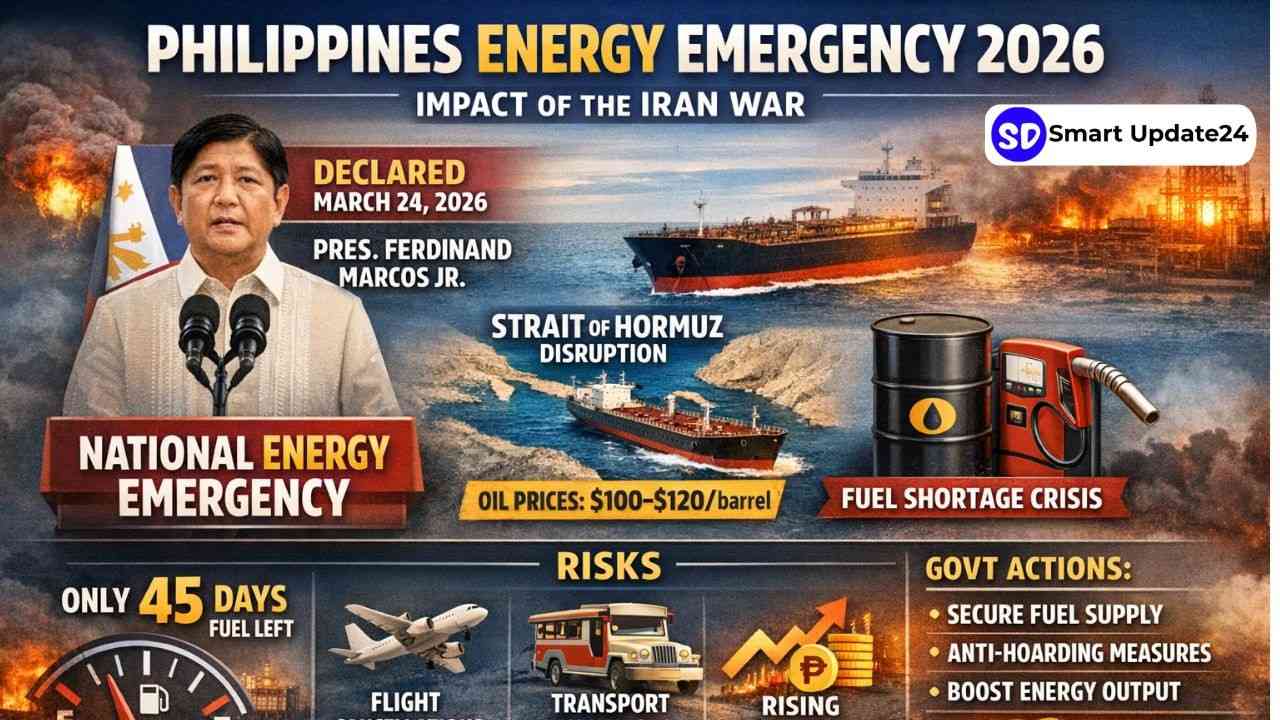
Philippines Energy Emergency 2026: The Philippines has declared a national energy emergency as the ongoing Iran war continues to disrupt global oil supplies, pushing prices higher and threatening fuel availability across energy-dependent countries.
Philippines Energy Emergency 2026 – Overview Chart
| Category | Details |
|---|---|
| Country | Philippines |
| Announcement Date | March 24, 2026 |
| Declared By | President Ferdinand Marcos Jr. |
| Emergency Type | National Energy Emergency |
| Main Reason | Global oil supply disruption due to Iran War |
| Key Global Trigger | Conflict affecting Middle East oil production & shipping routes |
| Critical Location | Strait of Hormuz (major oil transit route) |
| Oil Price Impact | Sharp rise (approx. $100–120 per barrel) |
| Fuel Dependency | High (imports majority of oil needs) |
| Fuel Reserve Status | Around 45 days stock remaining |
| Major Risks | Fuel shortage, flight disruptions, transport crisis, inflation |
| Government Actions | Securing fuel imports, price monitoring, anti-hoarding measures |
| Additional Measures | Boost power production, energy-saving policies |
| Duration of Emergency | Up to 1 year (initially) |
| Global Impact | Energy crisis affecting Asia, Europe, and global markets |
What Happened?
On March 24, 2026, Philippine President Ferdinand Marcos Jr. officially announced a state of national energy emergency, warning that the country faces an “imminent danger of a critically low energy supply.”
The emergency declaration will initially last one year, allowing the government to take urgent steps to secure fuel supplies, stabilize prices, and manage the distribution of essential goods like fuel, food, and medicines.
A high-level contingency committee has also been formed to oversee supply chains and prevent hoarding or price manipulation.
Related Article: OnePlus India CEO Robin Liu Resigns: Full Story, Reasons, and His Biography
Why Did This Happen?
1. Impact of the Iran War
The crisis is directly linked to the ongoing 2026 Iran war, which has severely disrupted global energy markets.
- Military conflict between the US, Israel, and Iran has damaged key oil and gas infrastructure
- Shipping routes in the Middle East have been affected
- Global oil supply chains are under stress
The situation has been described as one of the biggest global energy disruptions in history.
2. Strait of Hormuz Crisis
A major factor is the disruption of the Strait of Hormuz, a critical global oil route.
- Around 20% of the global oil supply passes through this narrow channel
- Conflict-related attacks and restrictions have reduced tanker traffic sharply
- Shipping disruptions have caused immediate supply shortages and price spikes
3. Rising Global Oil Prices
The war has triggered a massive surge in oil prices:
- Crude oil prices have jumped sharply due to reduced supply
- Some estimates show prices crossing $100–120 per barrel
- Asian countries, including the Philippines, are among the hardest hit
Why the Philippines Is Highly Affected
The Philippines is particularly vulnerable because:
- It is heavily dependent on imported fuel
- It has limited domestic energy production
- It relies on global supply chains for oil and gas
Officials warned that the country has only about 45 days of fuel reserves, raising concerns about shortages if supply disruptions continue.
There are also fears that:
- Flights may be grounded due to jet fuel shortages
- Public transport could be affected
- Inflation may rise sharply due to fuel costs
Government Measures Under the Emergency
The emergency declaration gives the government expanded powers to act quickly:
Key Actions
- Advance payments to secure fuel imports
- Increased monitoring of fuel distribution
- Crackdown on hoarding and black-market activities
- Boosting domestic power production (including coal plants)
- Preparing evacuation plans for citizens in the Middle East
Additionally, authorities are considering energy-saving measures, including reduced government operations and travel restrictions.
Public Reaction and Economic Concerns
The situation has already triggered concern among citizens and lawmakers:
- Transport groups are planning protests over rising fuel prices
- Economists warn of inflation and economic slowdown
- Currency and stock markets are under pressure
There is growing criticism of the government’s preparedness for such a crisis.
Global Context: A Wider Energy Crisis
The Philippines is not alone. The Iran war is creating a global energy shock:
- Up to 20 million barrels/day of oil supply is disrupted
- Countries across Asia and Europe are preparing emergency measures
- Airlines, industries, and the agriculture sectors are facing rising costs
Experts warn that if the conflict continues, the world could face:
- Energy shortages
- High inflation
- Possible global recession
Conclusion
The Philippines’ declaration of a national energy emergency highlights how deeply interconnected the global energy system is. A regional conflict in the Middle East has quickly turned into a worldwide crisis, affecting fuel prices, transport, and economic stability far beyond the war zone.
If the Iran conflict continues, the situation may worsen, forcing more countries to take similar emergency measures in the coming weeks.