


 Join our WhatsApp Group for Latest Updates
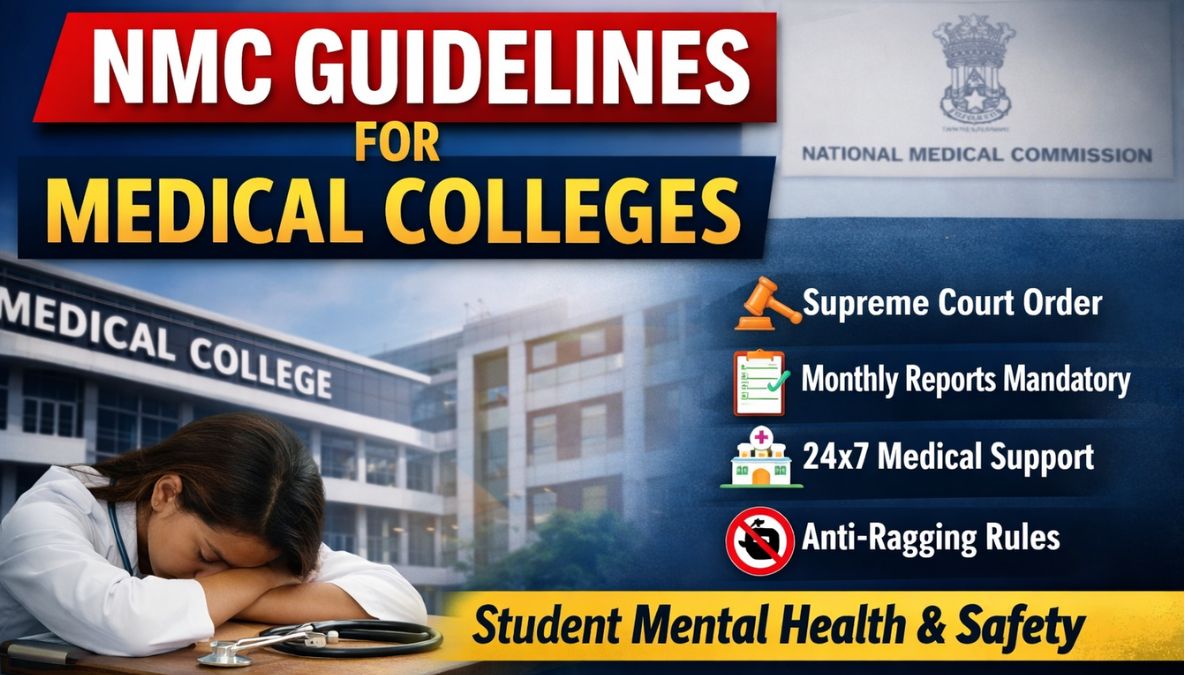
NMC Issues New Guidelines: The National Medical Commission (NMC) has issued a major public notice directing all medical colleges across India to implement strict measures to address student mental health, suicide prevention, anti-ragging compliance, and institutional accountability.
The directive follows the Supreme Court order dated January 15, 2026, in the case Amit Kumar & Others vs Union of India, which called for urgent reforms in higher educational institutions to prevent student suicides and improve mental health support systems.
NMC Issues New Guidelines for Medical Colleges 2026 – Overview
| Topic | Key Requirement | Timeline / Action |
|---|---|---|
| Supreme Court Order | Based on the Supreme Court directions in the Amit Kumar vs Union of India case | Immediate compliance required |
| Monthly Reporting | Medical colleges must submit an Action Taken Report (ATR) to NMC | Every month |
| Student Suicide Reporting | Institutions must report suicide/unnatural deaths and inform the police & family | Immediate reporting |
| Medical Facilities | 24×7 medical and emergency support required | On campus or within 1 km |
| Faculty Vacancies | All teaching and non-teaching posts must be filled | Within 4 months |
| Scholarships | Pending scholarships must be cleared | Within 4 months |
| Student Rights | Students cannot be barred from classes/exams due to scholarship delays | Mandatory compliance |
| Anti-Ragging Measures | Colleges must run anti-ragging committees, squads, and awareness programs | Continuous monitoring |
| Mental Health Support | Qualified mental health professionals must be appointed | Mandatory |
| Inclusion & Accessibility | Facilities required for PwDs and transgender students | Institutional responsibility |
| Non-Compliance | Regulatory action can be taken by the NMC | As per regulations |
| 09/03/2026 – Compliance with the Hon’ble Supreme Court of India Order dated 15.01.2026 in Criminal Appeal No. 1425/2025 in the matter of Amit Kumar & Ors. vs. Union of India & Ors. – reg. | NMC Issues New Guidelines Download |
Supreme Court Constituted National Task Force
Earlier, in its judgment dated March 24, 2025, the Supreme Court constituted a National Task Force (NTF) to examine mental health concerns of students in higher educational institutions and suggest preventive mechanisms. The task force is headed by Justice (Retd.) S. Ravindra Bhat, former judge of the Supreme Court.
After reviewing the interim report of the task force, the Supreme Court directed governments, regulators, and institutions to take immediate action to protect students and improve campus environments.
Following this order, the National Medical Commission has now instructed all medical colleges under its jurisdiction to strictly comply with these directives and submit regular reports.
Medical Colleges Must Submit Monthly Reports
According to the notice issued by Dr. Raghav Langer, Secretary of NMC, all medical colleges must submit a monthly Action Taken Report (ATR) to the Commission.
These reports must include detailed information about student welfare, mental health services, anti-ragging measures, faculty vacancies, scholarships, and campus safety.
Institutions have been instructed to send these reports via email to the official NMC anti-ragging portal.
Mandatory Reporting of Student Suicide Cases
One of the key directives is mandatory reporting of student suicide or unnatural deaths.
Educational institutions must:
- Immediately inform local police authorities
- Register an FIR in case of a cognizable offence
- Inform the student’s family without delay
- Document details such as age, course, place of incident, and investigation status
The data will help the government create reliable national statistics on student suicides, especially among students aged 15–29 years.
24×7 Medical and Emergency Facilities Required
The NMC has also directed all residential medical institutions to ensure round-the-clock medical support.
Colleges must provide:
- 24×7 medical facilities
- Emergency response protocols
- Ambulance availability
Medical services are either on campus or within a 1 km distance.
Related Article: Strong Growth in PG Medical Seats as NMC Expands Opportunities for Future Specialists
Vacant Faculty Posts Must Be Filled
Another major instruction focuses on faculty and administrative vacancies.
Medical colleges must fill all vacant teaching and non-teaching posts within four months, giving priority to reserved categories, including:
- SC
- ST
- OBC
- EWS
- Persons with Disabilities
Institutions must also submit annual vacancy reports to both the central and state governments.
Scholarship Delays Cannot Affect Students
The NMC has clarified that students must not face academic penalties due to delays in scholarships.
Colleges cannot:
- Bar students from attending classes
- Prevent them from taking exams
- Remove them from hostels
- Withhold mark sheets or degrees
- Force them to pay fees due to scholarship delays
Any pending scholarship payments must be cleared within four months.
Stronger Anti-Ragging Measures
The notice also mandates strict anti-ragging compliance.
Medical colleges must ensure:
- Anti-ragging affidavits from students and parents
- Awareness programs on campus
- Display of anti-ragging helpline numbers
- Regular reporting on the national anti-ragging portal
Ragging has been broadly defined to include:
- Physical harassment
- Psychological abuse
- Sexual harassment
- Discriminatory ragging based on caste, gender or religion
- Economic exploitation
- Academic interference
- Cyber or social media harassment.
Institutions must also report every ragging complaint and specify disciplinary actions taken, including suspension, expulsion, or police action.
Mental Health Counsellors Mandatory
The Commission has emphasized the need for professional mental health support on campuses.
Medical colleges must appoint qualified mental health professionals and ensure that untrained faculty members are not assigned counselling roles.
Colleges must also maintain:
- Confidential counselling systems
- Anonymous feedback channels
- Crisis intervention protocols for students.
Focus on Inclusive Campuses
The notice also highlights the need for inclusive infrastructure.
Institutions must ensure facilities for:
- Students with disabilities (ramps, lifts, assistive devices)
- Transgender students (appropriate hostel and sanitation facilities)
- Equal academic accommodations during examinations.
Non-Compliance May Invite Action
The National Medical Commission has warned that failure to comply with these directives could lead to regulatory action under NMC regulations and applicable laws.
The Commission expects medical colleges across the country to implement the guidelines strictly and submit regular compliance reports.
The new directives are expected to strengthen student safety, mental health support, and accountability in India’s medical education system.
Related Article: Big Update for Medical Colleges: NMC Orders ABHA ID Registration for All OPD & IPD Patients
FAQs – NMC Issues New Guidelines on Student Mental Health and Anti-Ragging in Medical Colleges
1. Why did the National Medical Commission issue this notice?
The National Medical Commission issued the notice to implement the directions of the Supreme Court regarding student mental health, suicide prevention, anti-ragging compliance, and improved support systems in medical colleges.
2. Which court case led to these new guidelines?
The guidelines were issued following the Supreme Court case Amit Kumar & Others vs Union of India, which addressed student mental health concerns and rising suicide cases in higher educational institutions.
3. What is the National Task Force mentioned in the notice?
The National Task Force was created by the Supreme Court to study student mental health issues and suggest measures to prevent suicides in colleges and universities across India.
4. What reports must medical colleges submit to the NMC?
Medical colleges must submit a monthly Action Taken Report (ATR) containing details about student welfare, suicide cases, anti-ragging compliance, faculty vacancies, scholarships, and mental health services.
5. What should institutions do if a student suicide occurs?
Institutions must immediately inform the police, register an FIR if required, inform the student’s family, and document all details of the incident for reporting to authorities.
6. Are medical colleges required to provide medical facilities on campus?
Yes. All residential medical colleges must ensure 24-hour medical and emergency health services, either on campus or within one kilometre of the institution.
7. What steps must colleges take regarding faculty vacancies?
All vacant teaching and non-teaching posts should be filled within four months, with priority given to reserved category posts as per government policies.
8. Can students be penalized if their scholarship is delayed?
No. The notice clearly states that students cannot be barred from classes, exams, hostel facilities, or academic documents due to delays in scholarship payments.
9. What types of ragging are prohibited?
Ragging includes physical harassment, verbal abuse, sexual harassment, discrimination, cyber bullying, economic exploitation, and academic interference with junior students.
10. What mental health support must colleges provide?
Medical colleges must appoint qualified mental health professionals, provide confidential counselling services, and create systems for early intervention and crisis support.
