





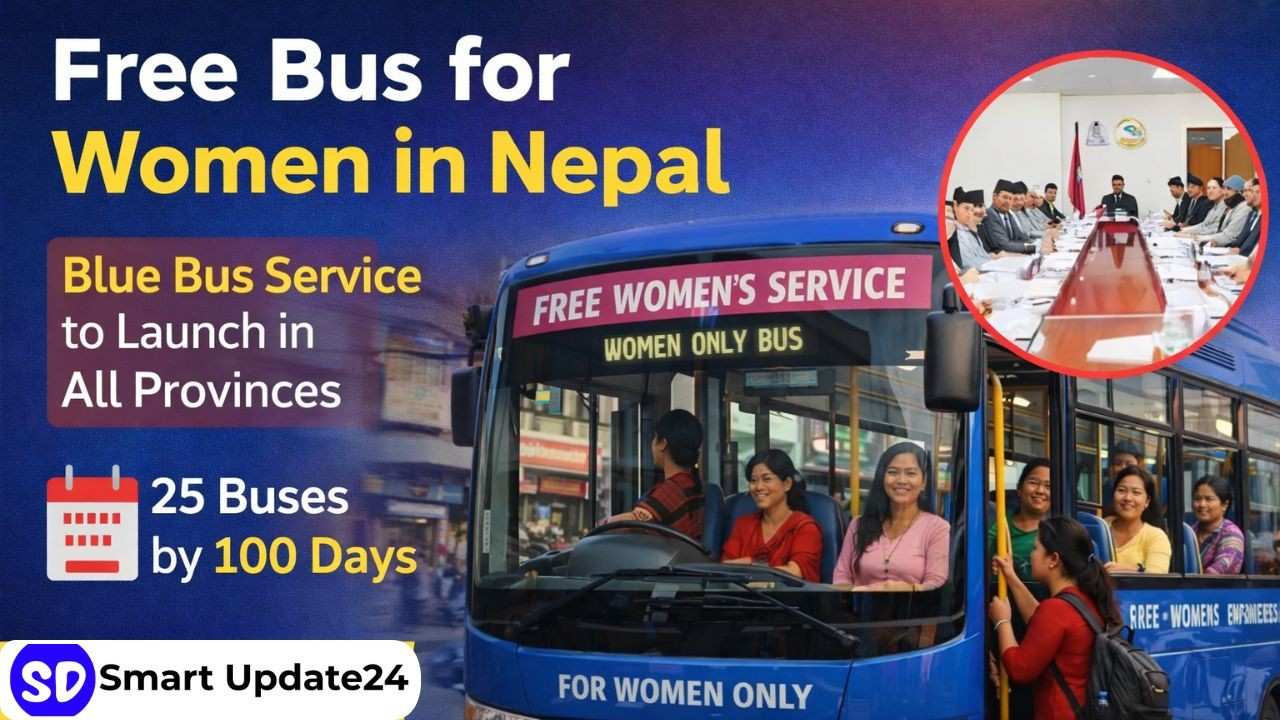
Nepal Free Bus for Women 2026: In a major step toward improving women’s safety and accessibility in public transport, the Government of Nepal has announced the launch of a free “Blue Bus” service exclusively for women. The initiative is part of the country’s newly introduced 100-point reform agenda, aimed at strengthening public services and social security.
The Nepal government has stated in its 100-point reform agenda that it will introduce a free “Blue Bus” service across all provinces to ensure safe transportation for women, with a target to operate at least 25 buses within 100 days in the first phase, aiming to improve women’s safety and accessibility in public transport.
The proposed service is expected to roll out across all provinces, offering safe, reliable, and cost-free travel for women commuters.
Nepal Free Bus for Women: What Is the “Blue Bus” Initiative?
The “Blue Bus” service is a women-only public transport system designed to address long-standing concerns around safety, affordability, and accessibility.
According to the plan:
- Only women passengers will be allowed onboard
- The buses will operate across multiple provinces
- Travel will be completely free of cost
- The initiative focuses on safer daily commuting
This move is expected to benefit working women, students, and daily commuters across urban and semi-urban regions.
Nepal Free Bus for Women 2026: Key Highlights of the Scheme
| Feature | Details |
| Scheme Name | Free Blue Bus Service |
| Target Group | Women Only |
| Cost | Free Travel |
| Coverage | All Provinces of Nepal |
| Phase 1 Target | 25 Buses |
| Timeline | Within 100 Days |
Timeline and Implementation Plan
The government has set an ambitious deadline:
- At least 25 buses will be operational within 100 days
- Initial deployment will focus on high-demand routes
- Gradual expansion is planned based on public response
This fast-track rollout shows the government’s intent to deliver a quick and visible impact.
Nepal Free Bus for Women: Why This Initiative Matters
Women’s safety in public transport has been a major issue across South Asia. Overcrowding, harassment, and lack of dedicated facilities often discourage women from using public buses.
This initiative aims to:
- Provide a secure commuting environment
- Encourage greater participation of women in education and jobs
- Reduce dependency on expensive private transport
- Improve overall urban mobility for women
Public Reaction and Expectations
The announcement has already generated positive reactions, especially among working women and students. Many see it as a progressive step toward gender-sensitive governance.
However, experts suggest that success will depend on:
- Proper route planning
- Regular bus frequency
- Maintenance and safety monitoring
- Long-term scalability beyond the first phase
Challenges Ahead
While the initiative is promising, some challenges remain:
- Ensuring a sufficient fleet size beyond 25 buses
- Managing operational costs for free services
- Preventing overcrowding during peak hours
- Maintaining consistent service quality
Addressing these issues will be key to the long-term success of the scheme.
Wiki: https://en.wikipedia.org/wiki/Government_of_Nepal
Related Article: PNG vs LPG | Why India’s Kitchen Fuel Battle Is Shifting Towards Piped Gas