


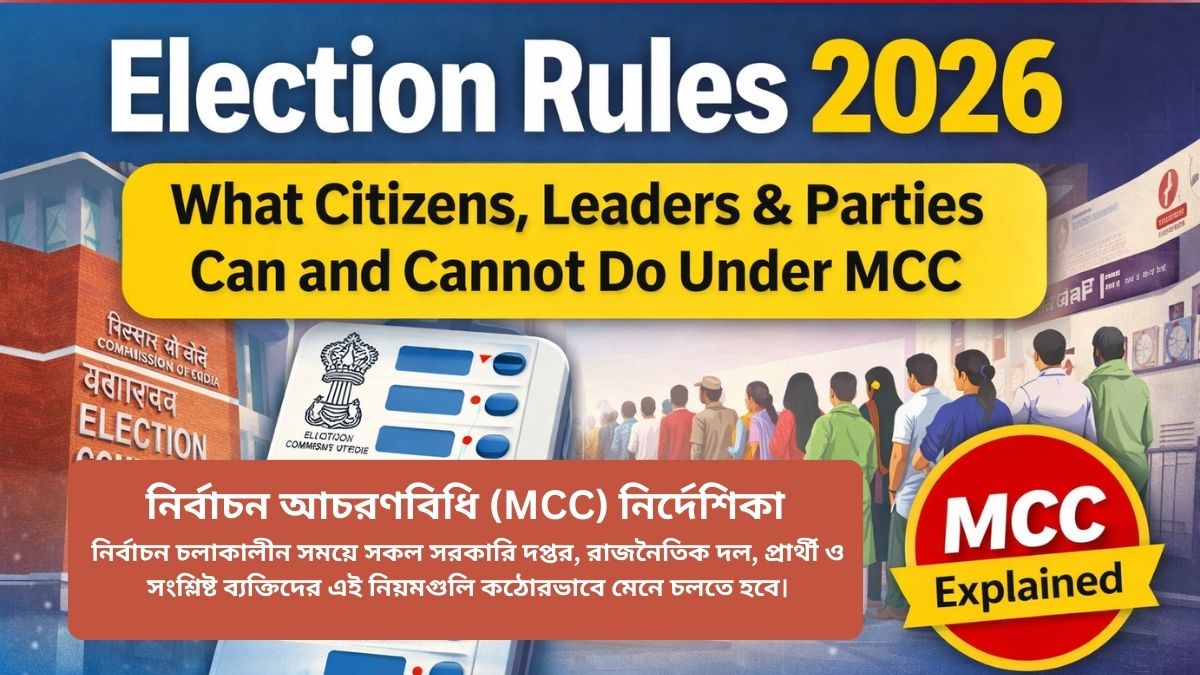
Election Rules 2026: The Election Commission of India (ECI) has officially enforced the Model Code of Conduct (MCC) after announcing the 2026 Assembly Elections in Assam, Kerala, Tamil Nadu, West Bengal, and Puducherry on 15 March 2026.
From the moment the election schedule is announced, strict rules come into force for governments, political parties, candidates, and even government departments. These rules ensure free and fair elections and prevent misuse of power or public resources.
This article explains the major rules in simple language so that the public clearly understands what is allowed and what is prohibited during the election period.
MCC 2026 Rules: What Citizens, Leaders and Political Parties Can and Cannot Do During Elections
What Is the Model Code of Conduct (MCC) Election Rules 2026 Explained?
The Model Code of Conduct is a set of guidelines issued by the Election Commission that regulates the behaviour of:
- Political parties
- Candidates
- Government authorities
- Public officials
It comes into effect immediately after the election schedule is announced and remains in force until the election process is completed.
Its main purpose is to ensure:
- Fair competition among political parties
- No misuse of government machinery
- Equal opportunity for all candidates
Related Article: West Bengal Election Date 2026: Full Schedule, Voting Phase, Result Date, and Everything You Need to Know
1. Posters, Banners, and Political Advertisements: Strict Deadlines
The Election Commission has ordered the immediate removal of unauthorized political advertisements.
Removal deadlines
| Type of Property | Deadline for Removal |
|---|---|
| Government buildings | Within 24 hours |
| Public places (bus stands, railway stations, etc.) | Within 48 hours |
| Private property without permission | Within 72 hours |
These include:
- Posters
- Wall writings
- Flags
- Banners
- Hoardings
- Cut-outs
Government offices, campuses, and buildings cannot display any political material.
2. Political Advertisements Cannot Use Public Money
Once elections are announced:
- Governments cannot advertise their achievements using public funds.
- No government advertisements praising schemes or leaders are allowed.
- Any such ads already released must be stopped immediately.
This rule applies to:
- Newspapers
- Television
- Radio
- Online media
The aim is to prevent ruling parties from gaining an unfair advantage using taxpayer money.
3. Photos of Ministers Must Be Removed from Government Websites
The Election Commission has ordered that:
- Photos of ministers or political leaders must be removed from official government websites.
- References to political parties on government portals must be deleted.
This ensures government platforms are not used for political promotion during elections.
Related Article: Yuvashree Scheme 2026 WB | 1,500 Monthly Allowance for Unemployed Youth – Full Details Explained
4. Ban on Use of Government Vehicles for Campaigning
A complete ban has been imposed on the use of official vehicles for election campaigning.
Vehicles belonging to the following cannot be used:
- Central Government
- State Government
- Public sector undertakings
- Municipal bodies
- Government boards and corporations
- Cooperative societies funded by public money
Only officials performing election duties are allowed to use official vehicles.
5. Rules for Campaign Vehicles
Candidates can use vehicles for campaigning, but only with proper permission.
Key rules include:
- Every campaign vehicle must have permission from the District Election Officer.
- The permit must be displayed on the vehicle.
- Vehicle details and driver information must be submitted.
Using vehicles without permission will be treated as unauthorized campaigning.
6. Limits on Vehicle Convoys
The Election Commission has imposed restrictions on large vehicle convoys.
Rules include:
- Convoys cannot have more than 10 vehicles together.
- If there are more vehicles, they must be separated.
- A gap of 100 meters must be maintained between groups.
These rules aim to prevent intimidation of voters and traffic disruption.
7. Rules on Election Day (Polling Day)
Strict limits apply on the day of polling.
For each candidate
Allowed vehicles:
- 1 vehicle for the candidate
- 1 vehicle for the election agent
- 1 vehicle for workers per assembly segment
Vehicles cannot be used to transport voters to polling stations, as this is considered an electoral offence.
8. Monitoring of Cash, Liquor, and Illegal Materials
The Election Commission has activated several monitoring teams:
- Flying squads
- Video surveillance teams
- Expenditure monitoring teams
Authorities will conduct checks for:
- Cash distribution
- Liquor distribution
- Drugs or contraband
- Illegal campaign materials
These steps aim to stop vote buying and illegal influence.
9. How Citizens Can Report Violations
Citizens can report election rule violations through:
Election Commission Helpline
📞 Toll-free number: 1950
Complaints can also be submitted through:
- Election Commission website
- Official complaint systems
After a complaint is filed, the complainant will receive updates via SMS about the action taken.
10. Educational Institutions Cannot Be Used for Campaigns
The Election Commission has clearly stated:
- Schools and colleges cannot be used for political rallies or campaigns.
- Their premises cannot be used for political activities during elections.
Why These Rules Are Important
The Model Code of Conduct ensures:
- Elections remain fair and transparent
- Government resources are not misused
- All political parties compete equally
- Voters can make independent decisions
Violating MCC rules can result in:
- Legal action
- Campaign restrictions
- Addition of expenses to candidate accounts
- Disqualification in serious cases
In simple terms of Election Rules 2026 Explained:
Once elections are announced, governments cannot promote themselves; political posters must be removed quickly, official vehicles cannot be used for campaigns, and strict monitoring begins across the country.
