


E-Passport Apply 2026: International travel is becoming more digital and secure, and India has taken a major step forward with the introduction of the E-Passport system. This new generation passport combines traditional passport features with modern electronic technology, making identity verification faster, safer, and more efficient.
Whether someone is traveling abroad for education, employment, tourism, or business, a passport remains one of the most important government-issued documents. With the launch of e-passports, the application process has also become more convenient, allowing citizens to complete most steps online from home.
An e-Passport is a combined paper and electronic passport with a Radio Frequency Identification (RFID) Chip and an antenna embedded as an inlay of passport that contains the personal particulars and biometric information of the passport holder. The ePassport will be visually identifiable as small additional gold colour symbol printed below the front cover of the passport.
What Is an E-Passport?
An E-Passport (Electronic Passport) is a smart passport that contains an embedded electronic chip inside the booklet. While it looks similar to a traditional passport, the chip securely stores the passport holder’s personal and biometric information.
This chip uses Radio Frequency Identification (RFID) technology, which allows immigration systems to quickly scan and verify the passport holder’s details at airports and border checkpoints.
The main purpose of the e-passport is to improve security, prevent forgery, and speed up immigration checks during international travel.
What Information Is Stored in an E-Passport?
The electronic chip embedded in the passport stores important digital information about the passport holder, including:
- Full Name
- Date of Birth
- Passport Number
- Digital Photograph
- Biometric Identifiers
- Personal Identification Data
All this information is stored in encrypted format following international security standards. This makes it extremely difficult to duplicate or manipulate passport data.
Because of this advanced technology, immigration officers can verify passenger identity quickly and accurately.
Why India Introduced E-Passports?
Many developed countries such as the United States, Japan, Germany, and Australia have already adopted electronic passports. By introducing e-passports, India aims to modernize its passport infrastructure and align with global travel security standards.
The key objectives of this initiative include:
- Strengthening passport security
- Reducing passport fraud and duplication
- Speeding up immigration checks
- Supporting automated border control systems
- Making international travel easier for Indian citizens
With increasing global mobility, such technological upgrades are becoming essential.
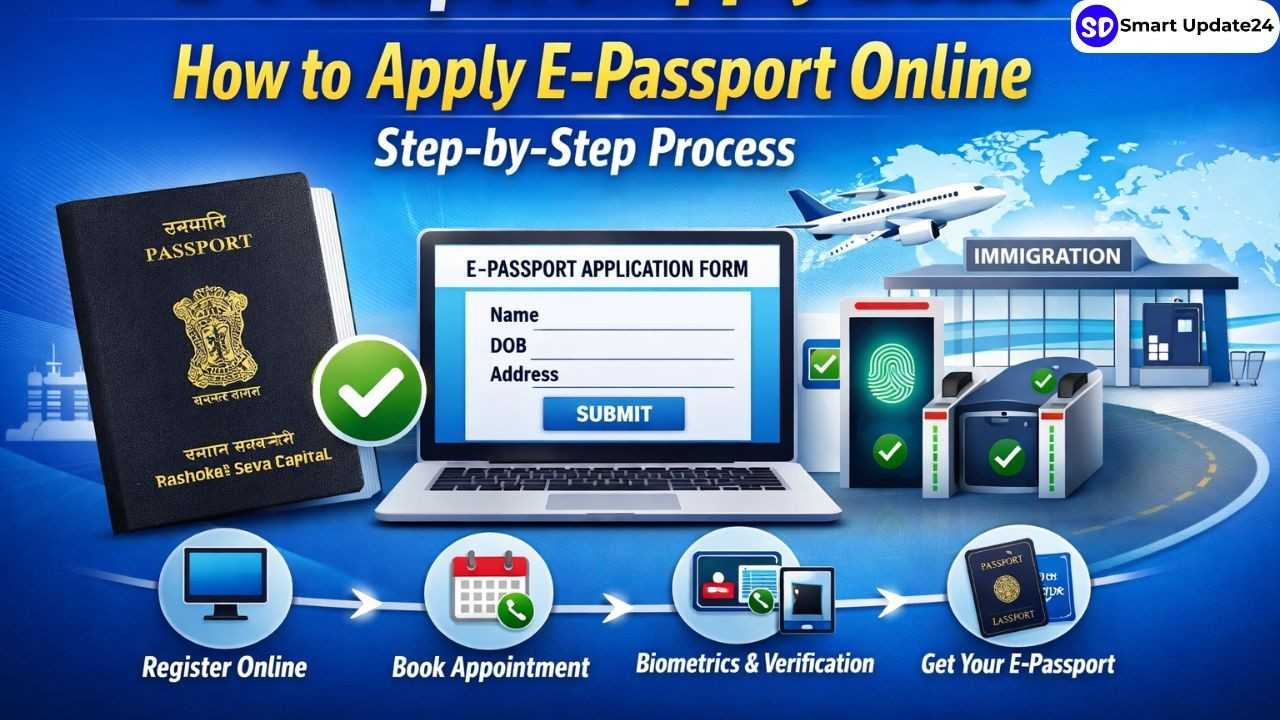
How to Apply for an E-Passport Online -step-by-step process:
One of the biggest advantages of the new passport system is the simplified online application process. Applicants no longer need to spend hours standing in queues.
Here is the step-by-step process to apply for an e-passport in India:
- Register on the Passport Seva Portal
Visit the official government portal and create an account.
Website: https://www.passportindia.gov.in
- Fill the Online Application Form
After logging in, complete the passport application form with details such as:
- Personal information
- Address details
- Identity proof
- Educational and employment information
- Pay the Application Fee
The passport fee can be paid online through net banking, debit card, credit card, or UPI.
- Book an Appointment
Choose the nearest Passport Seva Kendra (PSK) and schedule an appointment.
- Visit the Passport Seva Kendra
On the appointment date, visit the center with original documents for:
- Document verification
- Biometric data capture
- Photograph
- Police Verification
In many cases, local police verification is conducted to confirm the applicant’s address and identity.
- Passport Dispatch
After successful verification, the passport is printed and delivered to the applicant’s address.
Passport Fees and Tatkaal Service
The government has kept passport fees similar to previous rates so that citizens are not financially burdened.
There are two main application categories:
Normal Service
Standard processing time with regular fees.
Tatkaal Service
For urgent travel needs, applicants can choose the Tatkaal scheme, which allows faster passport processing by paying an additional fee.
This option is particularly helpful in emergency travel situations.
Benefits of the New E-Passport
The major benefit of the ePassport comes with an enhanced ability to maintain the integrity of passport holder’s data. The ePassport will have the data in printed form on the booklet, as well as digitally signed in the electronic chip, which can be securely authenticated by immigration officials globally; thus, safeguarding the passport from forgery, and potential fraudulent activities like fake passports, while confirming the genuineness at border controls.
The underlying technology supporting the security of the ePassport is the Public Key Infrastructure (PKI) solution which is the foundation for safeguarding sensitive information and confirming the integrity and origin of the personal and biometric data stored on the chip within the ePassport.
The introduction of smart passports offers several benefits for travelers.
Stronger Security
Encrypted biometric data reduces the chances of passport forgery.
Faster Immigration Clearance
E-passports can be scanned instantly at immigration counters.
Compatibility with Automated Gates
Many international airports now use automated immigration systems, which allow e-passport holders to pass through faster.
Improved Data Protection
Sensitive personal information is stored securely inside the electronic chip.
Reduced Waiting Time
Digital verification helps reduce queues at airports.
Importance of a Passport Beyond Travel
While most people associate passports only with international travel, the document also serves as a powerful identity proof.
A passport is accepted across India as valid identification for:
- Government services
- Banking and financial activities
- Employment verification
- Address proof
- International documentation
Because of its importance, improving passport security through modern technology has become essential.
The Future of Digital Travel in India
The introduction of e-passports is part of India’s broader move toward digital governance and smarter travel systems. Many airports around the world already use automated immigration gates and biometric verification systems.
With e-passports, Indian travelers will increasingly benefit from:
- Faster border control processing
- Secure identity verification
- Seamless international travel experience
As more citizens adopt this technology, India’s passport infrastructure will become more efficient and globally compatible.
Whether it is mandatory for the existing valid passport holders to replace their passports with an ePassport?
No. All Passports issued by Govt of India will continue to remain valid till their validity expiry date. As and when a respective Passport Office is technically enabled for issuance of ePassport, the citizens applying under that passport office will get the ePassport. The phase wise roll out of ePassport covering all Passport Offices across India may take few months.
Related Article: e-Passport Launched in India: Who Can Apply, How to Apply
