





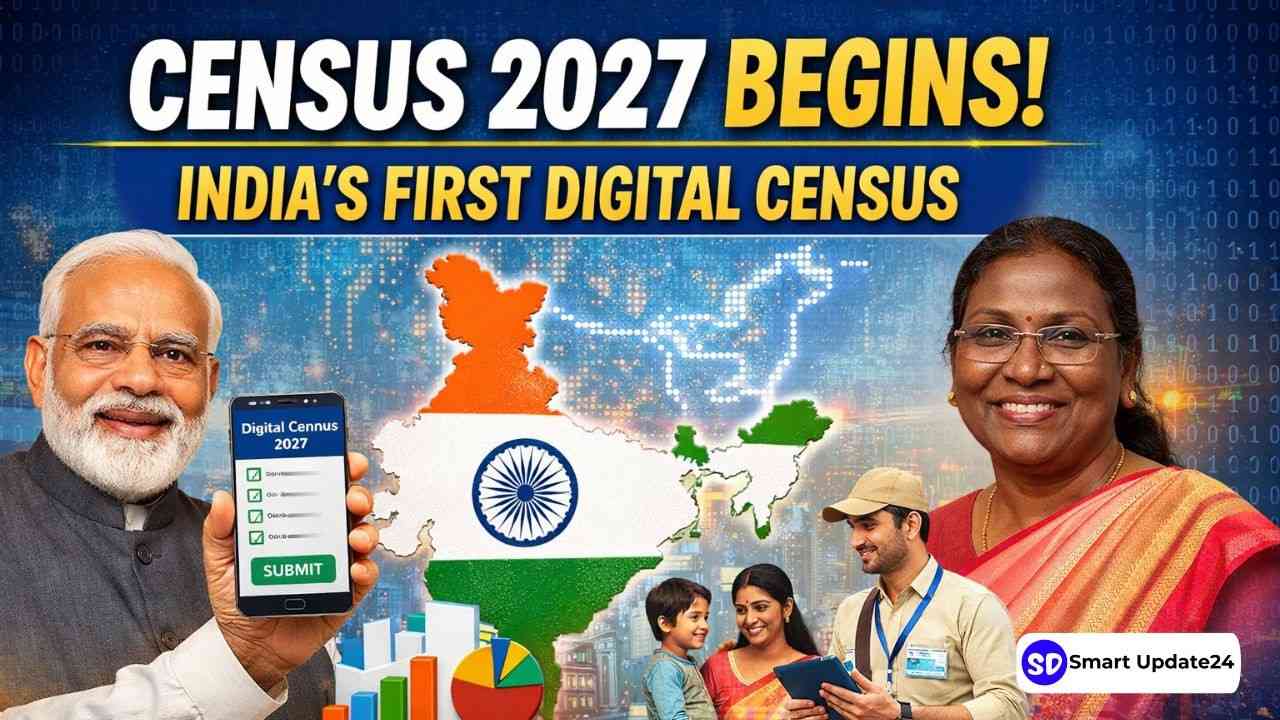
Census 2027 Begins: India has officially kicked off Census 2027, marking a historic transformation in how the country counts its population. Starting April 1, 2026, this massive national exercise is being conducted in a fully digital format for the first time, introducing self-enumeration and real-time data collection.
The 2027 Census will be the country’s 16th census and the 8th since independence. The census serves as the largest source of primary data at the village, town, and ward levels; it provides micro-level information on various indicators, including housing conditions, amenities and assets, demographics, religion, SC & ST, language, literacy and education, economic activities, migration, and fertility rates. The Census Act of 1948 and the Census Rules of 1990 provide the legal framework for conducting the census.
The 2027 Census in the country will be conducted in two phases.
Phase-I – House-listing and Housing Census (HLO) will be conducted across all States and Union Territories of India between April 1, 2026, and September 30, 2026, within a specific 30-day window determined by the respective State/Union Territory administration. Click here for details regarding the tentative State/Union Territory-wise timelines and questionnaires.
Phase-II – Population Enumeration (PE) will be conducted in February 2027.
In alignment with the government’s commitment to the ‘Digital India’ initiative, the 2027 Census will extensively utilize digital technology to enhance the quality, efficiency, and timeliness of data collection and dissemination. This will include the use of a specialized mobile application (the HLO Application) by enumerators for data collection, as well as a provision for ‘Self-Enumeration’ (SE) for the general public through a dedicated web portal. This web portal will remain open for a period of 15 days immediately preceding the door-to-door data collection by enumerators for the HLO phase.
The new census is not just another routine survey. It is being called the world’s largest digital population count, expected to reshape policy planning, governance, and development strategies across India.
Census 2027 Begins-Historic Start: Leaders Lead by Example
The launch of Census 2027 saw participation from top national leaders. President Droupadi Murmu and Prime Minister Narendra Modi were among the first to complete their self-enumeration, signaling the importance of citizen participation in this nationwide exercise.
Their involvement highlights the government’s push to make this census more inclusive, transparent, and technology-driven.
What Makes Census 2027 Different?
This census stands out due to several major innovations:
- India’s First Fully Digital Census
For the first time, data will be collected using mobile applications instead of paper forms, ensuring faster processing and improved accuracy.
- Self-Enumeration Facility
Citizens can now fill in their own census details online through a secure portal between April 1 and April 15, 2026.
After submission, a unique reference ID is generated, which can be shown to enumerators during field visits.
- Faster Data Availability
Because the process is digital, officials expect census data to be available much sooner, possibly within the same year.
Census 2027 Begins: Phase-Wise Census Plan
Census 2027 will be conducted in two major phases:
Phase 1: House Listing & Housing Census (April–September 2026)
- Begins April 1, 2026
- Includes 33 structured questions about housing conditions, assets, and amenities
- Self-enumeration available before field visits
Phase 2: Population Enumeration (February–March 2027)
- Covers individual details such as age, education, occupation, and more
- Final reference date: March 1, 2027
Massive Workforce Deployed Across India
To manage this enormous operation, the government has mobilized over 3 million enumerators and officials nationwide.
At the district level, preparations are already in full swing. For example, in Mysuru, thousands of personnel have been deployed, and residents are being actively encouraged to use the self-enumeration system to simplify the process.
Enumerators will later visit households to verify submitted data or collect information manually if needed.
How Self-Enumeration Works -step-by-step process
The new self-enumeration system is designed to be simple and user-friendly:
- Visit the official census portal: https://censusindia.gov.in/census.website/en
- Register using your mobile number
- Fill out household details (33 questions)
- Submit and receive a unique ID
- Show the ID to the enumerator during verification
If the ID is not provided, officials will conduct the full survey again.
Why This Census Matters
Census data plays a crucial role in shaping India’s future. It helps the government:
- Plan welfare schemes and policies
- Allocate resources efficiently
- Understand housing, employment, and population trends
- Improve infrastructure and public services
After a gap since the 2011 Census, this updated data will be critical for addressing current socio-economic challenges.
Key Highlights at a Glance
- Start Date: April 1, 2026
- First Digital Census in India
- Self-Enumeration Window: April 1–15
- Total Questions (Phase 1): 33
- Workforce: Over 3 million officials
- Final Population Count: Early 2027
Related Article: Digital e-Arrival Card | India Introduces from April 1, 2026, Big Change at Airports for International Travellers