





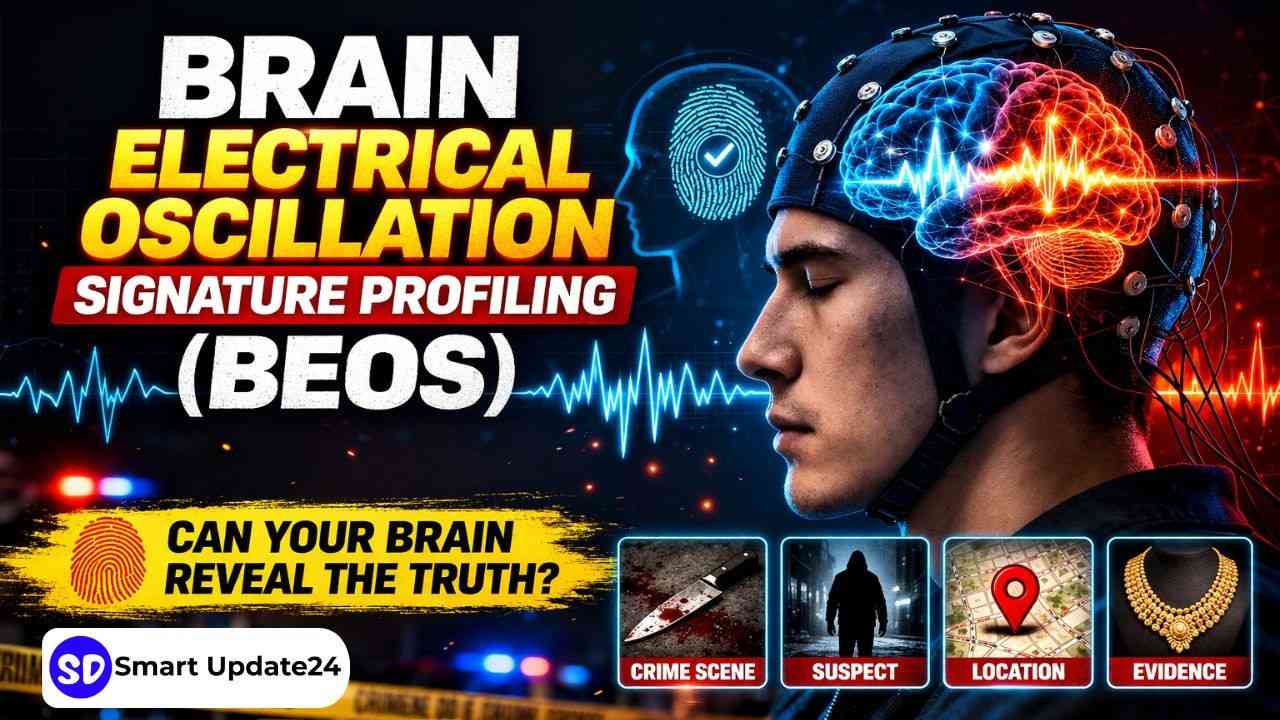
BEOS Test in India: In today’s world, science is helping police and investigators solve crimes faster and more accurately. One such modern technique is Brain Electrical Oscillation Signature Profiling (BEOS). It sounds complex, but the idea behind it is quite simple. It tries to understand what a person’s brain remembers.
Let’s break it down step by step.
Brain Electrical Oscillation Signature Profiling (BEOS) – Overview Chart
| Feature | Details |
|---|---|
| Full Form | Brain Electrical Oscillation Signature Profiling |
| Type of Test | Brain-based forensic test |
| Main Purpose | To detect whether a person has experienced a specific event (like a crime) |
| Technology Used | EEG (Electroencephalogram) |
| What it Measures | Brain electrical activity (oscillations) |
| Key Concept | Experiential Knowledge (real-life memory) |
| How it Works | Brain responses are recorded when a person is exposed to crime-related information |
| Need for Verbal Answer | No |
| Used In | Criminal investigations |
| Developed In | BEOS Test in India |
| Difference from Polygraph | Detects memory, not stress or lies |
| Accuracy Level | Not 100% confirmed, still under study |
| Legal Status in India | Cannot be forced, limited evidential value |
| Advantages | Scientific, no questioning, hard to manipulate |
| Limitations | Ethical concerns, memory confusion, not fully accepted in court |
| Common Use Cases | Murder, theft, terrorism investigations |
| Important Note | Used as supporting evidence, not final proof |
What is BEOS – Brain Electrical Oscillation Signature Profiling?
BEOS is a scientific test that studies brain activity to find out whether a person has experienced a particular event, like a crime. It uses a machine called an EEG (Electroencephalogram) to record electrical signals from the brain.
In simple terms, BEOS does not ask “Are you lying?” Instead, it asks, “Does your brain recognize this event?”
Because of this, BEOS is often called a type of “brain fingerprinting.”
Related Article: Aadhaar Card on WhatsApp: Step-by-Step Guide to Download Your Aadhaar via WhatsApp
How Does BEOS Work?
The main idea behind BEOS is very interesting. Our brain reacts differently to things we have actually experienced compared to things we only heard or imagined.
Basic process for BEOS Test in India:
- The person wears an EEG cap with sensors on the head
- The machine records brain signals
- The person is shown words, images, or situations related to a crime
- The brain reacts automatically
If the brain shows a specific type of response, it means the person may have experienced that event before.
The key point is:
The person does not need to speak or answer anything.
Brain Electrical Oscillation Signature Profiling
Important Concept: Experiential Knowledge
BEOS mainly looks for something called “experiential knowledge.”
This means knowledge that comes from real-life experience. For example:
- If you actually visit a place, your brain stores a detailed memory
- If you only heard about it, the memory is weaker
BEOS tries to detect this difference.
Related Article: Voter ID Card (EPIC) 2026: Apply Online, Correction, Address Change, Status Check & Download Digital Voter ID
Simple Example to Understand
Let’s say a robbery happened in a jewellery shop.
Case 1: Innocent person
If the police show this person a statement like:
“A gold necklace was kept in a red box.”
The brain may not react strongly, because the person never saw it.
Case 2: Real suspect
If the person actually committed the crime, their brain may show a strong response, because they remember that red box clearly.
This brain response is what BEOS tries to detect.
Difference Between BEOS and a Lie Detector
Many people think BEOS is like a lie detector, but it is quite different.
| Feature | BEOS | Polygraph (Lie Detector) |
|---|---|---|
| Measures | Brain activity | Heart rate, sweating |
| Based on | Memory recognition | Stress or fear |
| Needs answers? | No | Yes |
| Focus | Experience | Emotion |
BEOS is considered more advanced because it studies the brain directly, not body reactions.
Where is BEOS Used?
BEOS has mainly been used in criminal investigations in India. It has helped police in many cases to understand whether a suspect was involved in a crime.
Some uses include:
- Murder investigations
- Theft or robbery cases
- Terrorism-related cases
- Verifying statements of suspects
However, it is usually used as supporting evidence, not the only proof.
Legal Status of BEOS
Even though BEOS is a scientific method, courts have raised questions about its reliability.
In India, the Supreme Court ruled that such tests cannot be forced on a person and are not fully accepted as evidence.
This means:
- A person must give consent
- Results alone cannot decide guilt
Advantages of BEOS
BEOS has some clear benefits:
1. No need for questioning
The person does not have to speak or answer questions.
2. Hard to fake
Since it reads brain signals, it is difficult to manipulate.
3. Scientific approach
It uses neuroscience instead of guessing or pressure.
4. Useful in complex cases
Helps when there is little physical evidence.
Limitations and Criticism
Despite its advantages, BEOS is not perfect.
1. Not 100% accurate
Scientists say more research is needed.
2. Memory vs imagination
Sometimes the brain may react to imagined events, not real ones.
3. Ethical concerns
Some people believe it may violate mental privacy.
4. Not widely accepted
Many experts question its scientific reliability.
Because of these reasons, BEOS is still debated in the scientific and legal world.
Real-Life Use Example
In 2008, BEOS was used in a murder case in India. The test suggested that the accused had a memory of the crime. However, later courts questioned the validity of such evidence.
This shows that BEOS can help investigations, but it is not final proof.
Final Thoughts
Brain Electrical Oscillation Signature Profiling (BEOS) is a fascinating mix of science, psychology, and law. It tries to understand the truth by reading brain activity instead of relying only on words.
The idea is powerful: Your brain may reveal what you remember, even if you stay silent.
However, like many new technologies, it still needs more research and acceptance. For now, BEOS is a helpful tool, but not a final decision-maker in court.