




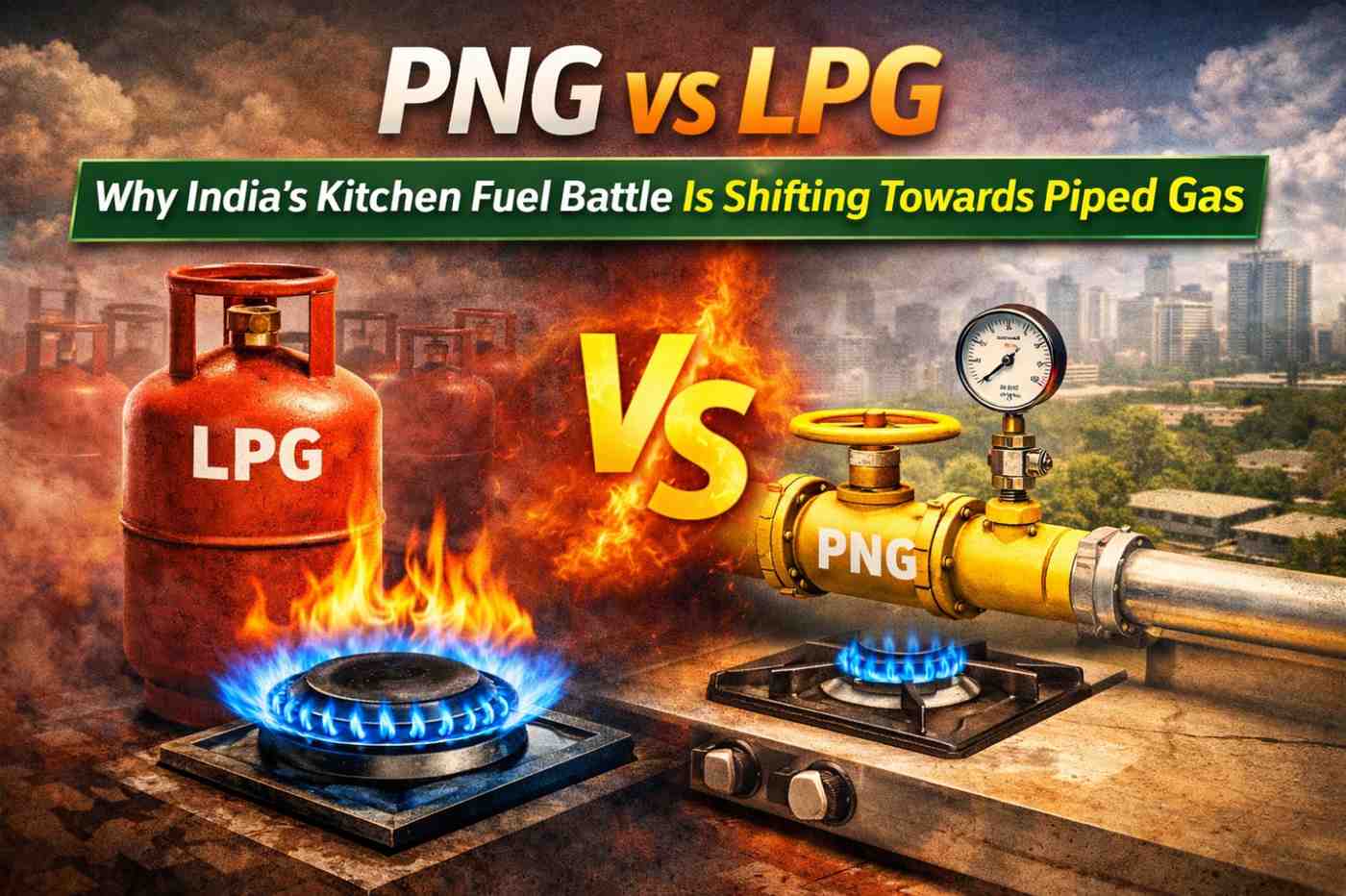
PNG vs LPG: In accordance with a directive issued by the government to accelerate the expansion of the natural gas network and reduce reliance on LPG, households utilizing LPG in areas where piped natural gas (PNG) infrastructure and supply systems already exist are now required to mandatorily switch to PNG.
As India’s LPG imports have been severely disrupted due to the ongoing conflict in West Asia, the government is urging consumers to transition to PNG—provided such facilities are available in their vicinity—in order to alleviate some of the pressure on LPG supply. To encourage consumers to opt for PNG connections, several ‘City Gas Distribution’ (CGD) companies have also announced special incentives; these include benefits such as the provision of a specific quantity of free gas and the waiver of connection fees. The Central Government has also called upon State Governments to assist in expediting the expansion of PNG networks, offering to allocate additional commercial LPG to states that undertake specific measures in this regard.
The Ministry of Petroleum and Natural Gas (MoPNG) has issued the ‘Natural Gas and Petroleum Products Distribution (Through Laying, Building, Operating, and Expanding Pipelines and Other Infrastructure) Guidelines, 2026’ under the provisions of the ‘Essential Commodities Act.’ The primary objective of these guidelines is to facilitate the expansion of PNG networks, enhance ‘last-mile’ connectivity, and encourage the increased utilization of natural gas across the domestic, transport, and industrial sectors. The government anticipates that the implementation of these guidelines will enable the release or conservation of LPG supplies in areas where PNG connectivity is available; consequently, this saved LPG can then be redirected to consumers in areas that currently lack any PNG infrastructure or facilities.
India’s kitchens are undergoing a quiet but significant transformation. For decades, Liquefied Petroleum Gas (LPG) cylinders have been the backbone of household cooking. But now, Piped Natural Gas (PNG) is steadily emerging as a strong alternative, especially in urban areas.
With expanding gas pipeline infrastructure and rising concerns around supply stability, pricing, and safety, the debate between PNG and LPG is becoming more relevant than ever.
What Is the Difference Between PNG and LPG? (PNG vs LPG)
At the most basic level, both PNG and LPG are fuels used for cooking, but they differ in composition and delivery.
- LPG is a mixture of propane and butane, stored in pressurised cylinders and delivered to homes.
- PNG is primarily methane, supplied directly through underground pipelines to households.
This difference in delivery system is what drives most of the advantages and limitations of each fuel.
What is Reticulation, and how is it applied in the context of natural gas?
Reticulation generally refers to the act or process of forming a network or grid system—specifically when something is distributed or arranged in a network-like configuration. Natural gas reticulation denotes the process of distributing natural gas from a central supply source to multiple users through a network of pipelines. This system is designed to efficiently deliver natural gas to households, commercial establishments, and industrial facilities, thereby enabling them to utilize it for various purposes such as cooking, space heating, and powering machinery.
Piped Natural Gas (PNG):
Piped Natural Gas—often simply referred to as ‘natural gas’—is a fossil fuel composed primarily of methane (CH4). It is extracted from underground reservoirs and subsequently undergoes various processing stages aimed at removing impurities such as water, carbon dioxide, sulfur compounds, and heavier hydrocarbons.
PNG: A Piped Natural Gas (PNG) reticulation system is a highly integrated network comprising pipelines and associated infrastructure, designed to deliver natural gas directly to households, commercial establishments, and industrial facilities. This system operates on a principle whereby natural gas is distributed from a central processing plant or import terminal to end-users with exceptional efficiency and safety, utilizing an interconnected grid of pipelines.
Why PNG Is Gaining Popularity in India
- Uninterrupted Supply and Convenience
One of the biggest advantages of PNG is continuous availability. There is no need to book cylinders or wait for delivery.
- Gas flows directly like a utility service (similar to water or electricity)
- No risk of running out of fuel during cooking
In contrast, LPG users must constantly track cylinder levels and book refills in advance.
- Better Safety Profile
Safety is a major factor pushing households toward PNG.
- PNG is supplied at very low pressure, reducing accident risk
- It is lighter than air, so it disperses quickly in case of leakage
- Modern systems include automatic shut-off valves
LPG, on the other hand, is heavier than air and can accumulate near the ground, increasing fire hazards during leaks.
- Cost Efficiency in the Long Run
While LPG cylinders may seem cheaper upfront (especially subsidised ones), PNG often turns out to be more economical over time.
- PNG is billed based on actual usage
- Prices are relatively stable compared to LPG
- No delivery or transportation costs
Studies and industry data suggest that PNG offers better long-term savings for regular users.
- Cleaner and Environment-Friendly Fuel
PNG is considered a cleaner fuel compared to LPG.
- Produces fewer emissions
- Burns more efficiently
- Contributes to better indoor and outdoor air quality
This aligns with India’s broader push toward cleaner energy solutions.
- Space-Saving and Hassle-Free
PNG eliminates the need for bulky cylinders in the kitchen.
- More usable kitchen space
- No cylinder storage or handling
- No physical effort required for replacement
This makes PNG especially attractive for apartments and urban homes.
Where LPG Still Holds Strong
Despite PNG’s advantages, LPG is far from obsolete. It continues to dominate in many parts of India due to practical reasons.
- Wider Availability
PNG infrastructure is still expanding and is mainly limited to urban and semi-urban areas. LPG remains the only option in many rural and remote regions.
- Higher Heating Efficiency
LPG has a higher calorific value, meaning:
- Faster cooking
- Stronger flame
This makes LPG preferable for high-heat cooking styles common in Indian kitchens.
- Portability
LPG cylinders can be used anywhere, making them ideal for:
- Rural households
- Temporary setups
- Areas without pipeline connectivity
The Infrastructure Push Behind PNG Growth (PNG vs LPG)
India’s government and energy companies are heavily investing in city gas distribution networks, expanding PNG access across cities and towns.
Recent trends show:
- Rapid growth in PNG connections in metro cities
- Pipeline networks expanding into smaller towns
- Increasing preference for PNG in new housing projects
This infrastructure push is one of the biggest reasons why PNG is “winning” in urban India.
The Supply Factor: A Hidden Driver
Global energy uncertainties have also played a role.
- LPG prices are influenced by international crude oil markets
- Supply disruptions can impact availability
- Governments may need to prioritise distribution during crises
PNG, being part of a domestic pipeline network, offers more stable and predictable supply, especially for households.
PNG vs LPG: Quick Comparison
| Feature | PNG | LPG |
| Supply | Continuous via pipeline | Cylinder-based |
| Convenience | High | Moderate |
| Safety | Safer (low pressure, disperses easily) | Higher risk in leaks |
| Cost | Cheaper long-term | Fluctuates |
| Availability | Limited to cities | Nationwide |
| Cooking Speed | Moderate | Faster |
The Future of Cooking Gas in India
The shift toward PNG does not mean LPG will disappear. Instead, India is moving toward a dual-system model:
- Urban India: Increasing adoption of PNG
- Rural India: Continued reliance on LPG
As pipeline networks expand, more households are likely to switch to PNG, especially in cities where convenience, safety, and cost efficiency matter most.
Related Article: LPG e-KYC Now Mandatory in India 2026 | How to link LPG Users with e-KYC -Step-by-step process -New Rules for Indane, Bharatgas and HP Gas Users
Know More: https://iocl.com/pages/PNGDomestic