





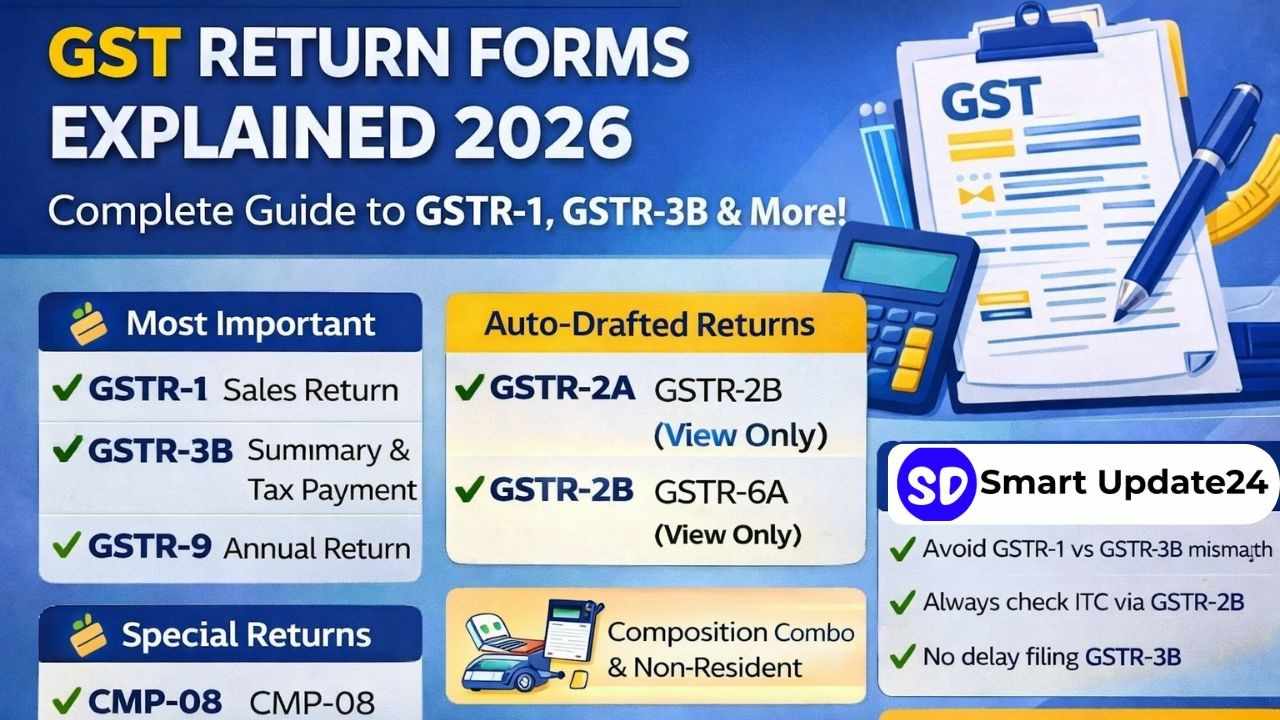
GST Return Forms Explained 2026 (NEW Rules): Understanding GST return forms is essential for every taxpayer in India. Whether you are a business owner, accountant, or student, knowing which GST forms to file and when can help you avoid penalties and stay compliant.
In India, every tax-registered business is required to file its GST returns, which contain details regarding sales, purchases, taxes paid, and Input Tax Credit. Filing these returns serves to declare your tax liability to the tax authorities. There are various types of GST returns.
Every registered taxable person must file their returns; however, the specific requirements depend on the scale and nature of the business. Regular taxpayers with an annual turnover exceeding ₹5 crore are required to file two types of monthly returns: GSTR-1, which details outward supplies (sales), and GSTR-3B, which provides a summary of sales, credits, and taxes paid. An annual return, GSTR-9, completes this yearly cycle.
Small businesses with an annual turnover of less than ₹5 crore may opt for the QRMP (Quarterly Return Monthly Payment) scheme, under which they file GSTR-1 and GSTR-3B on a quarterly basis rather than monthly.
Composition dealers falling under the simplified Composition Scheme file a quarterly return (CMP-08) and an annual return (GSTR-4). While special returns exist for e-commerce operators, TDS/TCS deductors, and non-resident taxpayers, most businesses primarily deal with GSTR-1, GSTR-3B, and GSTR-9.
Filing returns is mandatory for all GST-registered entities. Failure to file returns attracts heavy late fees, starting at ₹50 per day (₹25 CGST + ₹25 SGST) with an upper cap of ₹5,000; additionally, late payment of taxes incurs an annual interest charge of 18%. This system mandates the sequential filing of returns; if the return for November remains pending, you cannot file the return for December, thereby creating a cascading series of bottlenecks and exponentially increasing the penalty amount.
This guide simplifies all major GST returns, highlights the most important ones, and gives practical insights that professionals actually use.
Main GST Returns (Most Important GST Return Forms)
These are the core GST returns used in almost 90% of cases:
- GSTR-1 – Sales Return
- Used to report outward supplies (sales)
- Filed monthly or quarterly
- Includes invoice-wise details
- GSTR-3B – Summary Return
- Monthly return for tax payment and summary reporting
- Must be filed even if there is no business activity
- GSTR-9 – Annual Return
- Filed once a year
- Consolidates all GST transactions of the financial year
Key Tip: Every regular taxpayer must focus on these three forms to stay compliant.
Auto-Drafted Forms (View Only -GST Return Forms)
These forms are automatically generated by the GST system. You don’t need to file them, but you must check them carefully:
- GSTR-2A / GSTR-2B → Purchase data for ITC (Input Tax Credit)
- GSTR-4A → Auto data for composition taxpayers
- GSTR-6A → Auto data for Input Service Distributors (ISD)
These are view-only forms, mainly used for verification.
Special Category GST Returns
Certain taxpayers need to file additional returns based on their category:
- GSTR-4 → Annual return for composition dealers
- CMP-08 → Quarterly tax payment for composition scheme
- GSTR-5 → Non-resident taxable persons
- GSTR-5A → OIDAR (online services) providers
- GSTR-6 → ISD return
- GSTR-7 → TDS return
- GSTR-8 → E-commerce operators (TCS)
Other Important GST Forms
- GSTR-9A → Composition annual return (now mostly discontinued but still conceptually important)
- GSTR-9C → Audit and reconciliation statement
- GSTR-10 → Final return after GST cancellation
- GSTR-11 → UIN holders (for refund claims)
Practical GST Insights You Must Know
- Mismatch between GSTR-1 and GSTR-3B can lead to notices
- Always check ITC using GSTR-2B (not 2A)
- Late filing results in late fees + interest penalties
- Even small businesses must file GSTR-3B regularly
Easy Memory Trick for GST Returns
Remember GST forms easily with this simple trick:
- 1 = Sales (GSTR-1)
- 3B = Payment (GSTR-3B)
- 2B = ITC Check (GSTR-2B)
- 9 = Year-End (GSTR-9)
Bonus Professional Tips for GST Return Forms Explained
- CMP-08 + GSTR-4 work together for composition taxpayers
- GSTR-2B is the most reliable ITC reference today
- GSTR-9C applies only if turnover crosses audit limits
FAQs
Q1. Which GST return is most important?
GSTR-1, GSTR-3B, and GSTR-9 are the most important.
Q2. Is GSTR-2B mandatory?
No, but it is essential for checking ITC.
Q3. What happens if GST returns are not filed?
Late fees, interest, and possible legal notices.
Q4. Who files GSTR-4?
Composition scheme taxpayers.
Q5. Is GSTR-9C compulsory?
Only for businesses meeting audit threshold limits.
Official Website: https://tutorial.gst.gov.in/userguide/returns/Manual_gstr9.htm
Related Article: Voter ID Card (EPIC) 2026: Apply Online, Correction, Address Change, Status Check & Download Digital Voter ID