





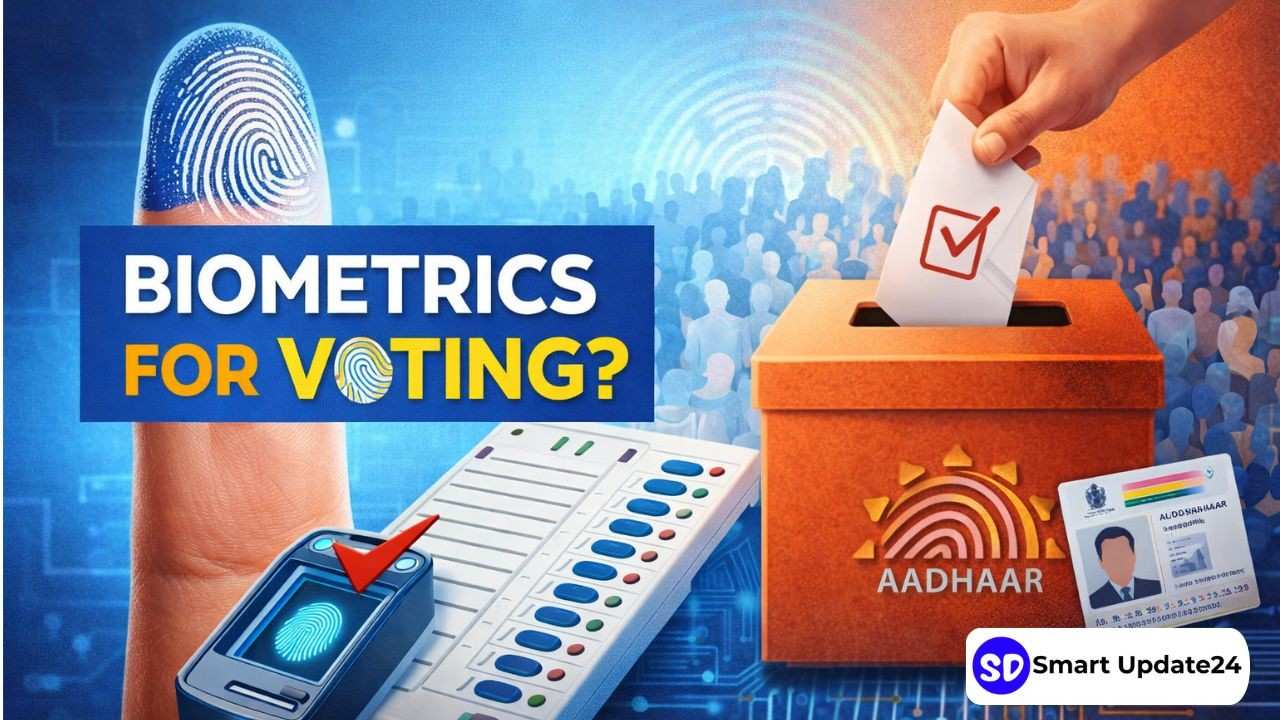
Fingerprint Voting in India: A recent remark by Raghav Chadha has reignited a nationwide discussion on the future of India’s electoral system. Drawing attention to the growing use of biometric authentication in welfare schemes, he questioned: if fingerprints are already required for accessing essentials like ration, fertilizers, and pensions, why shouldn’t similar technology be used for voting?
Biometric Voting Debate – Overview
| Category | Details |
|---|---|
| Topic | Use of biometric (fingerprint) authentication in voting |
| Triggered By | Statement by Raghav Chadha |
| Current Use of Biometrics | Ration distribution, urea purchase, pension schemes via Aadhaar |
| Key Proposal | Introduce fingerprint verification in elections |
| Main Objective | Prevent fake voting and duplication |
| Supporting Authority | Elections managed by the Election Commission of India |
| Advantages | Eliminates bogus voters, improves transparency, builds trust |
| Challenges | Privacy concerns, data security risks, and exclusion of voters |
| Technical Issues | Fingerprint mismatch, connectivity problems, and device reliability |
| Legal Concerns | Protection of voting secrecy and constitutional rights |
| Public Opinion | Divided between security benefits and privacy risks |
| Future Scope | Pilot testing, legal framework, data protection policies |
Growing Use of Biometrics in Welfare
Over the past decade, biometric authentication—primarily through Unique Identification Authority of India (UIDAI)—has become central to public service delivery. Programs linked with Aadhaar have helped streamline benefits by ensuring that subsidies and entitlements reach genuine beneficiaries.
From the Public Distribution System (PDS), ration access to pension disbursements and fertilizer purchases like urea, biometric verification has significantly reduced duplication and leakages. Supporters argue that this success could be replicated in elections.
Related Article: End of 28-Day Recharge | Govt Pushes Telecom Companies 30-Day recharge Plans for Mobile Users Across India
The Case for Fingerprint Voting in India
Advocates of biometric-enabled voting believe it could address several long-standing concerns:
- Eliminate bogus voting: Linking voter identity to fingerprints can prevent impersonation.
- Remove duplicate entries: Biometric systems can ensure one person, one vote.
- Boost trust: A transparent and verifiable system may strengthen public confidence in elections.
- Efficiency: Faster voter verification could streamline polling processes.
Many see it as a natural technological progression in a country already leveraging digital identity at scale.
Concerns Over Privacy and Accessibility
Despite its potential, the proposal raises serious concerns. Critics caution that voting is not just a transactional activity but a fundamental democratic right that depends heavily on secrecy and inclusivity.
Key concerns include:
- Privacy risks: Storing and using biometric data in elections could expose sensitive personal information.
- Data security: Large-scale biometric databases are potential targets for breaches.
- Exclusion issues: Technical failures, worn fingerprints (common among manual laborers), or connectivity issues could disenfranchise voters.
- Legal and ethical questions: Whether such a system aligns with constitutional guarantees of free and fair elections remains debated.
Related Article: Earth Hour 2026 | India Gate to Victoria Memorial Goes Dark as Millions Join Global Climate Movement (From Delhi to Kolkata)
Balancing Technology and Democratic Values
India’s electoral system, overseen by the Election Commission of India, is already considered one of the largest and most complex in the world. Any move toward biometric voting would require not only technological readiness but also strong legal safeguards and public consensus.
Experts suggest that before any implementation, pilot projects, transparent audits, and robust data protection frameworks must be in place.
The Road Ahead
The debate sparked by Raghav Chadha reflects a broader question facing modern democracies: how to integrate technology without compromising core democratic principles. While biometric authentication offers promising solutions to electoral challenges, it also demands careful evaluation.
For now, the conversation continues—balancing innovation with rights, and efficiency with inclusivity.